by Greg Walcher, E&E Legal Senior Policy Fellow
The Daily Sentinel
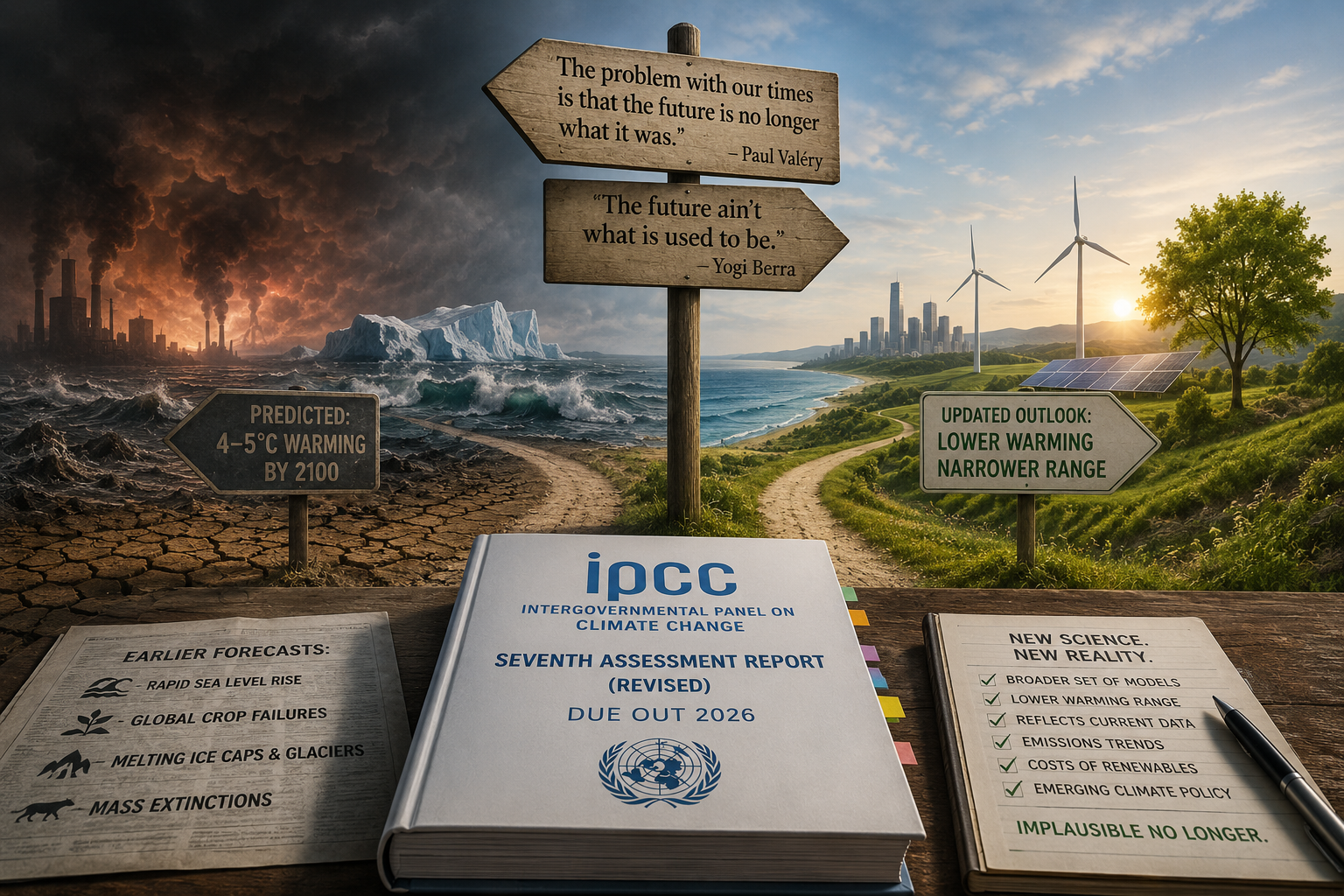
In 1937 the French poet and philosopher Paul Valéry published “Reflections on the World Today,” in which he originated one of literature’s great lines: “The problem with our times is that the future is no longer what it was.” The line was perfected later by Yogi Berra, who said simply, “The future ain’t what is used to be.”
Neither Valéry nor Berra were thinking about climate change, but it is a pithy way of recognizing that what was once widely — almost universally — expected to happen is no longer considered probable. Not even by the same experts who once insisted the science was settled.
The United Nations’ Intergovernmental Panel on Climate Change (IPCC), is revising and editing its “Seventh IPCC Report,” due out next year, and we have already learned that it has “adjusted its modeling framework.” That means IPCC will no longer defend its primary scenarios, known as SSP5-8.5 and SSP1-1.9, published in 2017, and upon which most of the world’s climate change policies were based — they were cited more than 45,000 times in academic papers and government studies. Those scenarios predicted a 4-5 degree Celsius (7-9 degrees Fahrenheit) warming by the year 2100. That framework was used by hundreds of scientists around the world for their own analyses that forecast a dramatic rise in sea levels, global crop failures, rapid melting of polar ice caps and glaciers, and mass extinctions.
Now 45 IPCC scientists are citing more current data and writing in the Geoscientific Model Development journal that a broader set of models will alter the new IPCC report. “For the 21st century, this range will be smaller than assessed before,” they write, and the earlier forecasts — which have been touted as settled science — “have become implausible, based on trends in the costs of renewables, the emergence of climate policy, and recent emission trends.”