by Greg Walcher, E&E Legal Senior Policy Fellow
The Daily Sentinel
At this month’s Western Conservative Summit in Denver, I watched an extraordinarily moving interview Wil Armstrong filmed with former Sen. Ben Sasse, while the latter is undergoing treatments for advanced stage four pancreatic cancer. Sasse’s clarity and vision are rare among political figures, especially on the relative unimportance, and destructive power, of “idolatry in politics.”
Even while acknowledging his impending departure from this life, Sasse courageously runs an astonishingly popular podcast and has published several books. My favorite is “Them: Why We Hate Each Other and How to Heal.” He cites declines in life expectancy and birth rates, and documents that communities are collapsing. Little Leagues are disappearing. Service clubs are dwindling. Most people don’t know their neighbors. No institutions command widespread public trust — not the government, the press, universities, environmental groups, not even scientists. Nearly half of Americans think the other political party isn’t just wrong; it’s evil. That isn’t about politics — it’s about loneliness.
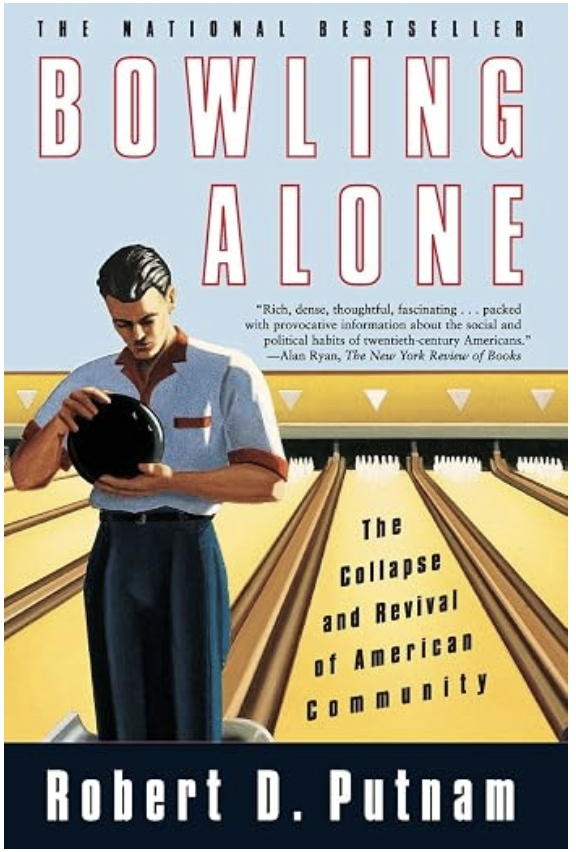
It is a compelling follow-up, almost a sequel, to Robert Putnam’s 2000 best-seller, “Bowling Alone.” Putnam assembled evidence from a wide range of activities, showing that Americans are becoming less connected to one another through voluntary associations, civic life, neighborhoods, religion, and work. The title example is that Americans are still bowling, but bowling alone rather than joining organized leagues. The activity survives while its social institution declines.
The phenomenon is evident in organizations everywhere, with membership and participation declining not just in bowling leagues, but PTAs, service clubs, fraternal orders, veterans’ organizations, labor unions, trade associations, and local clubs. Even in groups with sustained membership, Americans are increasingly less likely to attend meetings, serve on committees, or take leadership roles. The same is true in civic affairs, with declines in public meeting attendance, volunteering on campaigns, and serving on boards and committees. A large majority of voters prefer to remain unaffiliated rather than join either party. People are not less interested in public affairs — they’re less interested in the face-to-face, local activities where citizens used to become friends and work together.